
Settling for brutality
Inside new report on prison excessive force

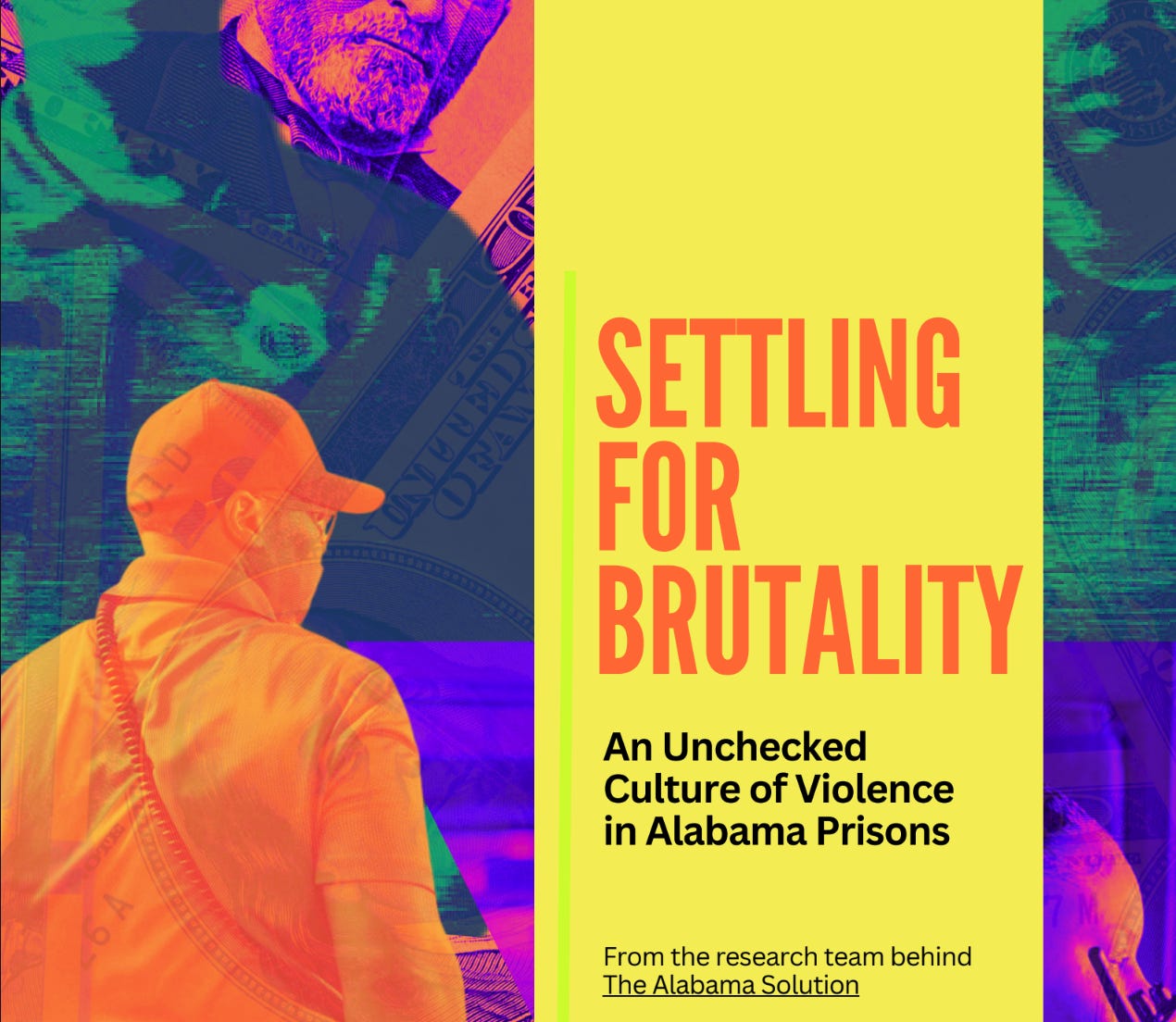
Since 2020, the Alabama Department of Corrections has spent $68 million on lawyers.
$68 million!!!
That’s one of the main takeaways in a new report I co-wrote with Chris Izor, associate producer of The Alabama Solution. Chris and I are both continuing to support the film’s impact campaign, and that includes producing more investigative reports connected to the crisis inside Alabama prisons.
A huge chunk of ADOC’s outrageous legal bills includes the legal defense of officers sued for excessive force and paid settlements to victims. Since 2020, the cost to taxpayers has increased nearly fivefold compared to the previous five years.
This money comes out of a state liability trust fund, a taxpayer-funded resource that works like insurance for state employees, to cover them if they’re sued on the job. ADOC is draining this fund, siphoning more in the last five years than every other state agency combined.
By tracking the use of this fund, we identified the repeat offenders, the same correctional officers and supervisors named in multiple excessive force lawsuits, over and over again, with no recourse. Whistleblower Melvin Ray explained this scheme in The Alabama Solution. “The state is settling one lawsuit after another, and these people do not get fired, they do not get suspended,” he said. “The state pays their legal bills, the state pays the settlement.” We found nothing in these officers’ personnel records to reflect the pattern of abuse allegations against them.
Low pay for officers is not part of the story here. The officers on our list, all still employed by ADOC, earn an average of $153,000 a year, and many of them have gotten promoted while excessive force litigation against them was still active. So it isn’t just that ADOC looks the other way when officers abuse people in their care, the agency has a pattern of rewarding abusive officers with a higher rank and salary.
Our aim in publishing this information is to shine a light into the darkness. Taxpayers deserve to know what’s being done in our names, with our money. And this is a massive pile—$68 million is larger than some state agency’s annual budgets— and is happening while incarcerated people live in excruciating and dehumanizing poverty. I think of this legal spending like a shadow economy, or part of what prison scholar Ruth Wilson Gilmore coined the “non-state state,” the way government has reorganized and expanded coercive and punitive capacities. We may not always be aware that this is happening, but this is happening, and we need to know about it.
This reporting also pushes back against the argument that Alabama prisons are violent because the people locked up in them are violent. The truth is, prisons reflect a culture set by the agency in charge, not by the people stripped of their rights and assigned a number in place of their name. Sure, prisons have gangs, and leaders in the population, but whether or not the environment itself is violent or nonviolent, orderly or lawless is almost exclusively under the purview of prison administration and the agency in charge.
When speaking to a legislative committee earlier this year, former ADOC commissioner John Hamm tried to blame the prison crisis on the incarcerated population, as if some uniquely awful characteristic of the state’s imprisoned citizens is causing the runaway violence and disorder in the system, and not mismanagement of the institutions and predatory corruption among drug-dealing staff.
“That inmate population is about 80 percent violent,” he told the committee, referring to data from the Alabama Sentencing Commission on the number of people sentenced to prison in Alabama for violent crimes. “When you start congregating those people together like that, there are issues,” Hamm said.
Those people.
This argument is asinine.
Every prison population across the United States holds people convicted of violent crimes. If what Hamm said is true, then every prison in America would be just as dangerous and deadly as those in Alabama.
The percentage of violent vs. nonviolent people in prison has little to do with dangerousness and mostly reflects how the state defines violent crime.
The exact same population that Hamm claims is 80 percent violent, is only 60 percent violent, according to the federal government’s definitions. The Bureau of Justice statistics slices up the rest of Alabama’s prison population between property offenses (15%), including burglary, which Alabama defines as violent, drug offenses (14%), and public order offenses (8%), which includes gun charges, another batch of violent crimes as defined by Alabama.
Republican candidate for attorney general Katherine Robertson echoed this “blame the victim” speak about the dysfunction and chaos inside Alabama’s prison system, when speaking at a debate.
“Alabama’s prisons are full of violent offenders,” she said. “In fact, it is a very difficult population to manage and incarcerate, but that is not a reason to turn away from harsh sentences, it’s just dealing with the reality that, for some reason, we have violent crime in different places in Alabama, and the way we deal with it is to get them off the streets and put them away.”
Putting them away may be true for some crimes on the street, particular when they involve Black people, who are arrested at a higher rate and receive longer prison sentences. But when it comes to correctional officers who break the law or commit acts of excess brutality, the way we deal with it is to hire an attorney and defend them on the taxpayer dime, no matter how horrific the allegations.
I hope you’ll read our entire report, share it, and ask the people running for office whether they’ll keep settling for brutality in our prisons, or if they have a plan to create a more transparent and constitutional system, in which abusive repeat offenders are held accountable, and no longer given unlimited, legal resources, a fat paycheck and a free pass to beat incarcerated people, and sometimes kill them, with no consequences.

Thank you for sharing this, Beth. The very people who are the most wounded and in need of help we treat so horrendously. If only prisons were actual places of rehabilitation and healing, the whole society would benefit.
Hey Beth! This post needs to be widely shared! I wish there was a way to estimate what each taxpayer has had to pay. Thank you for showing that salary. To that I say WTF. People who have Masters and doctoral degrees are lucky to make anywhere near that!
One thing I wish you will elaborate on is the remark about Black people being more likely to do violent crimes. I know you did not mean it the way I first read it, but others may wonder about it as well. Maybe it’s just my feeble 75 yo mind messing with my ability to comprehend things, but just thought I’d give a heads up 😁. I can’t wait to read the full report and send it to others.