
Do the crime, do the time
Unpacking indifference to incarceration's harms

Public service message: don’t go to prison.
Prison is punishment and should not be a country club.
The only thing corrupt is those inmates and those of you who support those inmates.
These are a few comments in response to The Alabama Solution, a new HBO documentary exposing rampant violence, drug abuse and despair inside the Alabama Department of Corrections. I co-produced the film over six years with directors Charlotte Kaufman and Andrew Jarecki, and now remain transfixed by the response, much of playing out across various social media platforms.
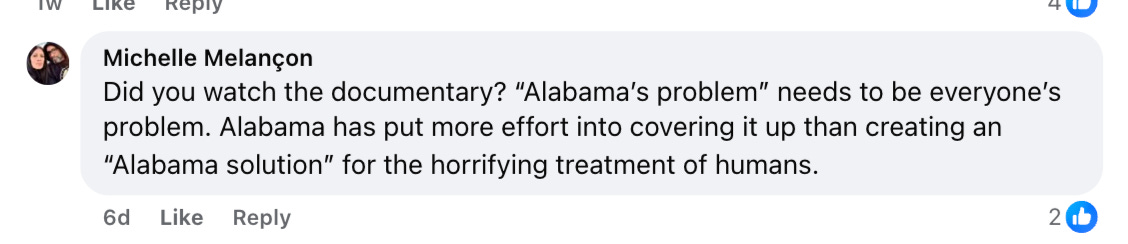
It’s heartening to read many comments of support, outrage, compassion and calls for reform. But that’s not what I want to write about here. I want to focus on the other bucket of comments, from what I call the “do the crime, do the time” set.
I’ve grown accustomed to hearing from this contingent, ubiquitous to any discussion about crime and punishment. They often invoke crime victims, and their central message is any variation on the theme of do the crime, do the time.
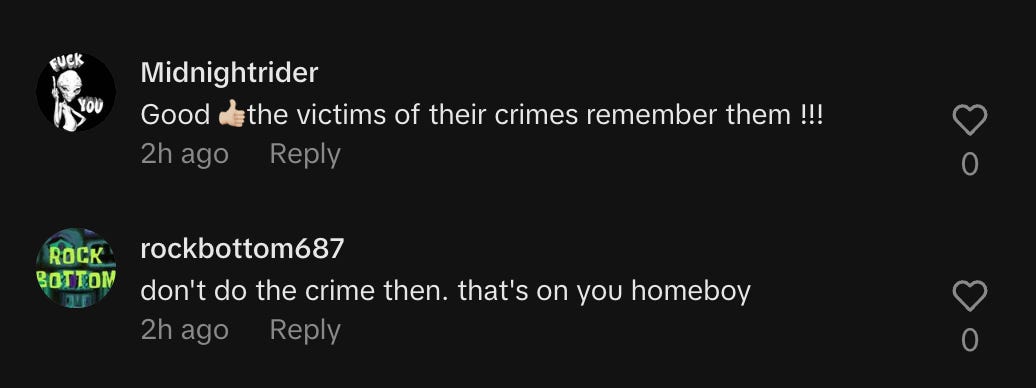
It’s a short way of saying no matter how horrifying the experience of prison, we don’t want to hear about it, because the blame falls squarely on the person experiencing the harm. They landed themselves in prison and must reap the consequences, no matter how bloody, terrifying or outright criminal.
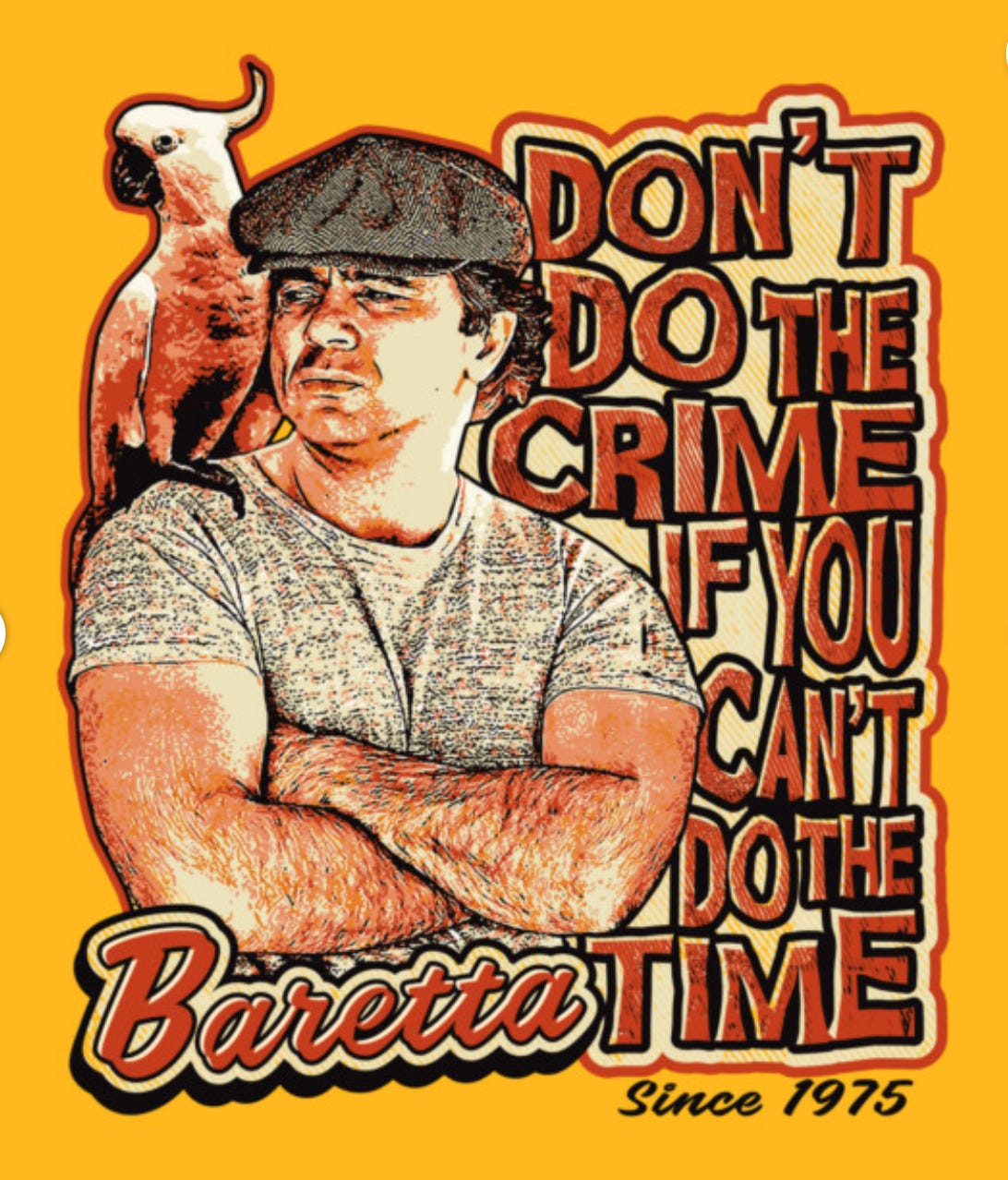
Where does this mindset come from? Google links it to the popular ABC-TV series “Baretta” that ran from 1975-1979, and featured a swaggering undercover police officer in New York with the same name.


Detective Tony Baretta, played by actor Robert Blake, who ironically was charged with murdering his wife in 2001 and later acquitted, went after bad guys with a cigarette dangling from his lips, newsboy cap on his head. He also had a pet white cockatoo named Fred. Baretta’s catchphrases included “Don’t do the crime if you can’t do the time,” as well as the less enduring “You can take dat to da’ bank.”
But let’s be real, this mindset is far more complicated than a simple reflection from pop culture. All these people who respond to suffering in prison by blaming the victim didn’t receive such hard programming exclusively from a 1970’s cop show.
My reporting and research over the last decade attributes this attitude to complex and deeply ingrained influences including frontier culture, religion, racism, classism and what Distinguished Social Psychology Professor Craig Haney, Ph.D., calls the “crime master narrative,” the belief that people who commit crimes are fundamentally and inherently bad, and their bad acts are simply a matter of personal, autonomous choice, made freely, “unencumbered by past history or present circumstances.”1
In other words, all bad choices are viewed as “willful and selfish,” and the person who made them is solely responsible, not only for their own actions, but also for the overall “crime problem in our society.” Their past and present circumstances, “no matter how daunting, insurmountable, or extreme,” Haney argues, are viewed as largely irrelevant to understanding why they committed a crime and determining the consequence.
This belief is not supported by science. What Haney and others who study human behavior argue is that crime is not committed in a vacuum. “The roots of criminal behavior lie primarily in the backgrounds and social histories of those who commit it and the immediate criminogenic contexts in which it occurs,” writes Haney.
The backgrounds and histories that incubate crime — poverty, illiteracy, abuse, addiction, mental illness, and so on, are completely ignored or viewed as excuses, not causes of crime, in the crime master narrative.
The Alabama Solution captures this mindset in several scenes, perhaps nowhere more clearly than the scene in which Andrew Jarecki asks Alabama Attorney General Steve Marshall to talk about the nature of crime. Marshall answers, “I think there are evil people in the world. And I think there are individuals who have absolutely no regard for human life.”

That’s it. The crime master narrative summed up in a single answer. If we buy this notion that evilness is the singular motivator of crime, and everyone who commits crime is evil, doesn’t that make the cruelties perpetuated by the system much easier to swallow? Maybe even celebrate? I mean, who wants to advocate that evildoers deserve better treatment?
Executions seem to bring out the most vitriolic version of this attitude, as if the state killing a person isn’t punishment enough. Just read the comments on any news story when someone is executed. Actually, don’t read the comments. They’re awful. Here’s one example from Anthony Boyd’s recent execution by nitrogen hypoxia.

I’ve discussed this punching down phenomenon with sources in prison. “Strap us down to ant beds every day and these folks still wouldn’t be happy,” one told me. Incarcerated people, it seems, might be the last class of people you can totally trash, publicly demean, or even wish violence on, and it’s all still socially acceptable.
At the same time, many do the crime, do the time folks say what they say with crime victims in mind. Some have actually suffered harm themselves and channel their grief and outrage into voicing contempt for people in prison. Sometimes they accuse me of not caring about crime victims, like compassion has a finite supply, a carton of milk that can be emptied. Pouring glasses for people in prison means crime victims must go thirsty.
When I first began hearing this years ago, I felt confused because my work is largely motivated by compassion and empathy for all people who are suffering, regardless of circumstance. I’ve reported countless stories on victims of crime, but I also don’t hold a purity test for who qualifies for compassion. To me, suffering is suffering, no matter the context, in or out of prison. Compassion is limitless. It never runs out.
I also do not buy into a “hierarchy of human life,” described by Nicholas Kristof in recent writing about Gaza. Kristof accurately points out President Biden’s hypocrisy of condemning the slaughter of Jewish children by Hamas, while struggling to articulate the same outrage on behalf of Palestinian children. This ranking of human lives can also explain Alabama’s lack of urgency in addressing prison atrocities. The sons of Alabamians killed while incarcerated seem less of a priority than everyone else and not worth saving.
But if I’m going to think deeply about this, I can’t ignore the harm of crime or the pain that crime victims carry. I covered crime for 20 years in TV news, and often came face to face with the extreme sorrow that violent crime brings.
A moment in 2016 stands out, when I was sent to an active murder scene in Birmingham. Before I even got out of the news truck, I assessed what was happening beyond the yellow police tape, people streaming out of small houses, forming clusters in the street, shouting.
I squinted through the windshield and realized there were two separate groups of people, shouting furiously at each other. And then I spotted the body of a woman on the ground, parallel to the curb, a small sedan parked just a few feet away. Her body was face up and curved to the side slightly, one arm splayed over her head, like she collapsed while in motion. Oh God, she was running away from the person who shot her, I thought.
Just then, a car rolled by and stopped haphazardly at the barricade. A woman jumped out wearing what appeared to be a restaurant worker’s uniform— black pinstripe pants, a white button-down shirt, hair tucked into a black bonnet. She stumbled toward police, two officers catching her before she hit the ground.
A guttural wail left her mouth that sounded ancient, more animal than human. The shouting in the street subsided and suddenly the only sound you could hear was her cry, slicing through the chilly afternoon. I remember her upturned, agonized face, body in a heap, and her voice communicating a sorrow that has no words.
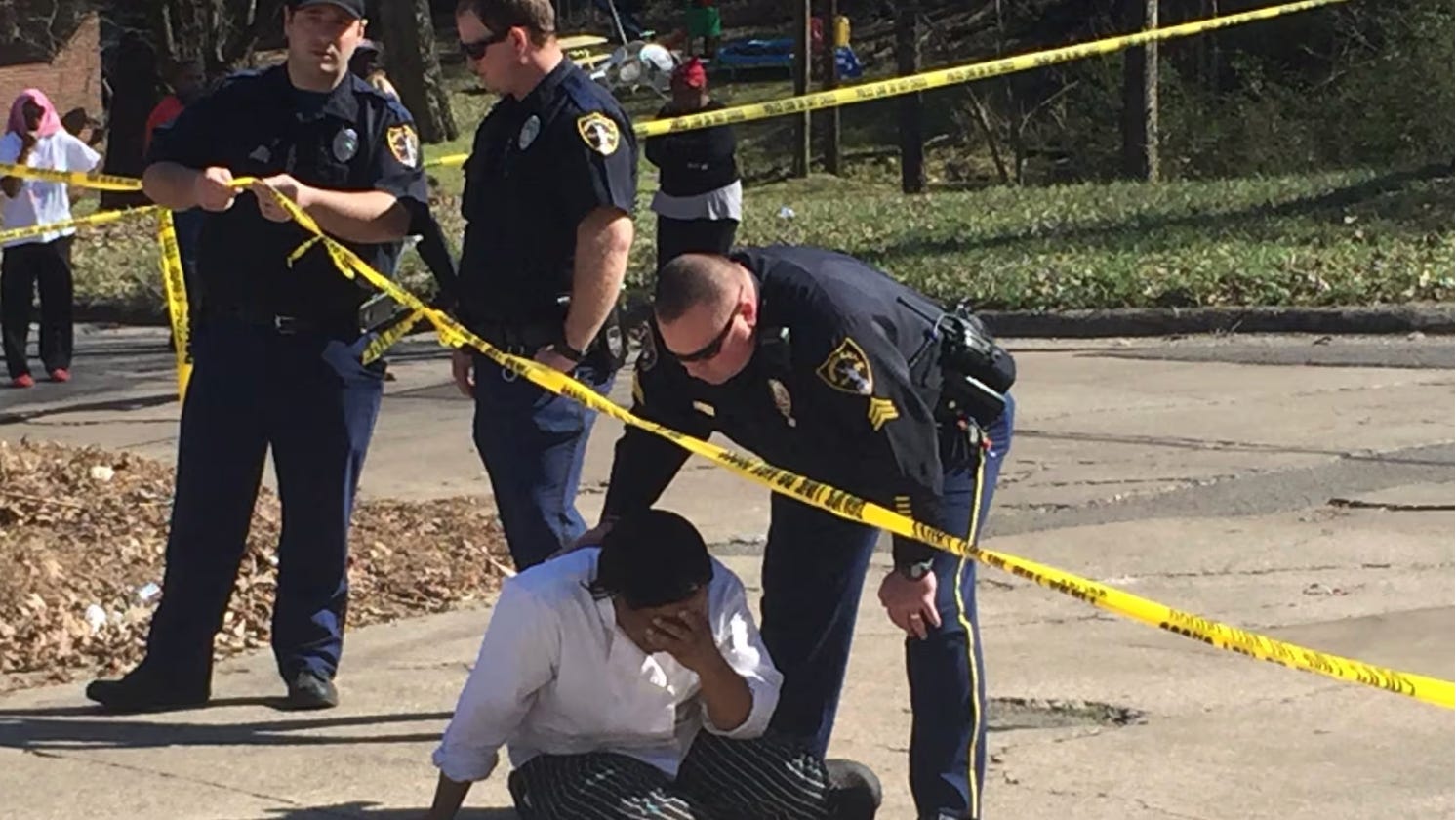
This woman’s anguished scream was the most truthful response to the situation, but I was somehow unable to convey it when I wrote the news story—the who, what, where, when and why about the crime. I felt like the worst kind of peeping tom, wordlessly witnessing her despair from the comfort of the news truck, then driving away with the info I needed, off to package human suffering into product.
Shortly after covering this murder, I spoke to one of my best sources in prison, a man convicted of murder when he was a teenager. When I accepted his call from the prison phone system and heard his voice, an image of this woman weeping in the street popped into my head.
I immediately felt a sense of recoil, imagining the destruction and devastation of all murder victims’ families, and I wanted to get off the phone. His voice repulsed me, an unusual hostility bubbled in my center, like lava of a newly awakened volcano that had long been dormant.
As he talked, completely unaware of my inner disgust, I thought What is this weird animosity? I’d been speaking to this man for years and was no longer fixated on the crime he committed, I barely thought about it anymore. He was just another person I knew and talked to regularly. In fact, he’d become someone I truly cared about and considered a friend. What was going on?
After our call, I pondered my negative feelings. This was complex interior terrain to weed through, but I had the benefit of carrying a lighter emotional load as a journalist and witness, not a victim. After considerable thought, journaling and time, I finally landed on this: I had to be willing to hold multiple truths at the same time.
Yes, my friend committed a murder, and it was devastating. Yes I had just covered a murder that was also devastating, but he didn’t have anything to do with it. I had unwittingly transferred emotional baggage from the crime scene into misguided anger and disgust directed at my friend. He caused that kind of devastation too, I had thought, the crime master narrative doing its work.
It took slowing down and examining my thoughts and feelings in that moment for me to separate my friend’s crime from the murder I had just covered. He had shot and killed an innocent person long ago, but the master narrative was telling me to hold him personally responsible for every murder. The sudden, bitter disdain I felt about what he’d done, and my inexplicable aversion to his voice that day made sense.
No wonder so many families of crime victims remain angry, carrying hostile contempt not just for the person who harmed them, but for all other people who have caused harm. Our justice system stokes the fires of retribution, and offers little for them to heal.
All this came to mind after a recent interaction with a woman on X, one of the many people who clap back at calls for prison reform with claims that it harms victims. But instead of arguing after her call-out below, we began to engage in a thoughtful back and forth. It turns out her cousin was murdered and she’s still grieving the loss, as well as the system’s failure to produce justice, closure or peace for her family.

After the above retweet, she asked me why I believed people in prison were not responsible for their own predicament. “If they are clearly continuing their life of criminal activity behind bars,” she wrote, “to me this makes an even stronger argument for how they are exactly where they belong. Let them kill each other— the rest of us are safe from them.”
I laid out the rational argument for why prison violence is a system failure, and not the fault of prisoners held inside. Then I challenged her to consider the case of Daniel Williams, who was killed in a horrific recent case of ADOC’s hellish violence.
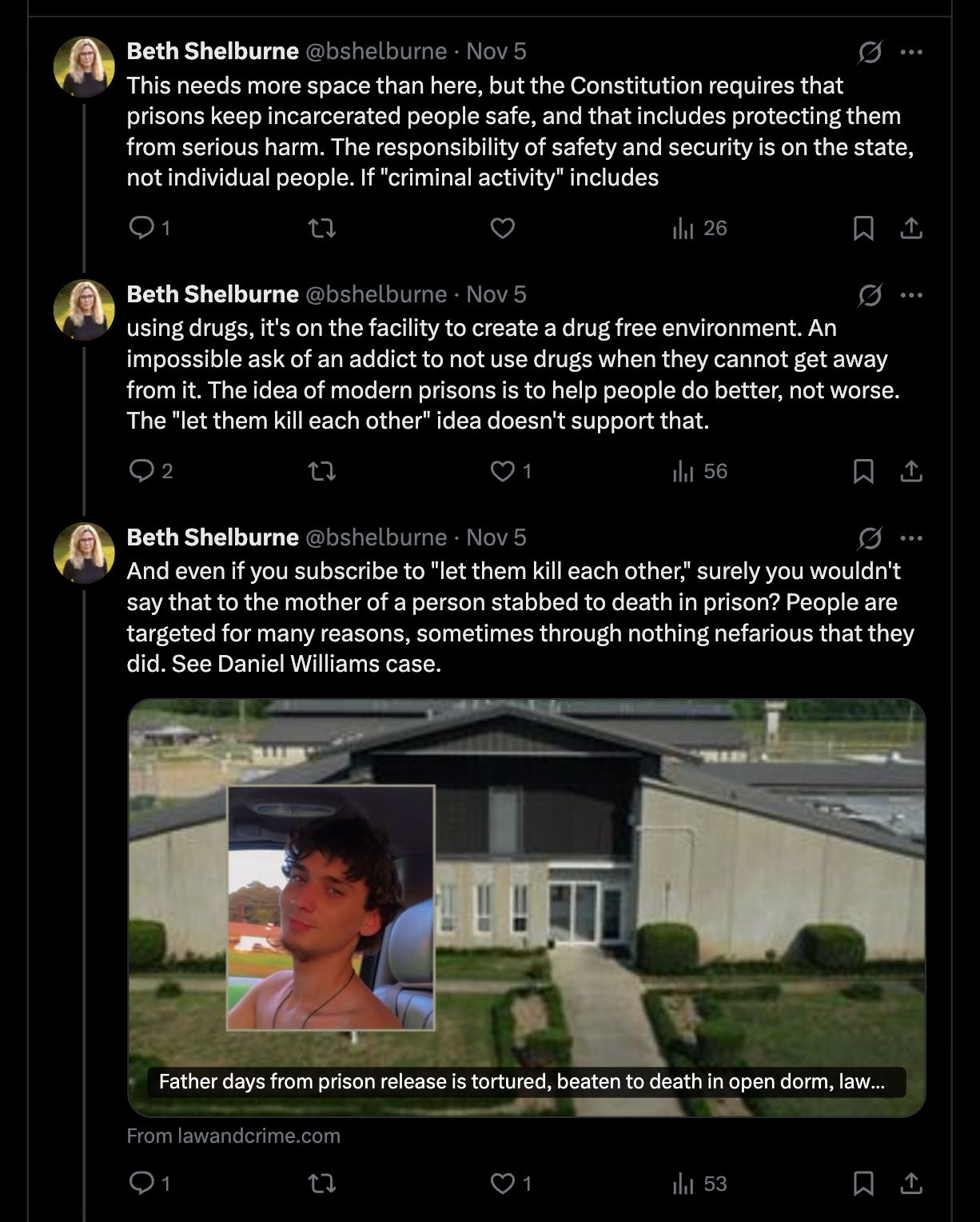
Daniel was held hostage inside Staton prison, drugged, raped and tortured for days before he died on the very day he was supposed to be released. It’s a breathtaking example of multiple institutional failures. Who could ever argue that Daniel deserved that?
The woman on X read an article I linked about Daniel’s murder, and later admitted that what happened to him was horrible. “The prisons should be better than the criminals they house,” she wrote. “But honestly, most of the time I don’t care how they’re treated. Maybe once I deal with the trauma from our case I’ll feel differently.” She also asked what Daniel did to land himself in prison. Our exchange is below.

It appears she was able to slow down and interrogate her own thoughts and feelings, much like I did when I felt unexpected animosity toward my friend in prison. This takes patience and intention, as well as a willingness to admit to ourselves that we’re not the center of the universe, not the easiest thing to do when you’ve been wronged.
It’s not rocket science. Each of us took a breath, then engaged in meaningful dialogue instead of trading barbs and staying mad. I felt more connected to her pain, and understood better why she felt the need to snipe at me about prison reform. She and I found some common ground, and now my upper back feels less tight when I see her name in my mentions. I get where she’s coming from. As Michelle Obama says, it’s harder to hate up close.
But this idea that if you commit a crime, you must accept the consequences has morphed into a sinister affirmation that prison abuse is OK because it’s simply the result of an individual’s decision to break the law. That no matter how awful, up to rape, torture and murder, they “did it to themselves” by ending up in prison.
This dismisses the barbarity of prison as normal, even righteous, and any calls for human and civil rights amount to special treatment. This is the “structural immorality” baked into our carceral system, a term created by postwar sociologist C. Wright Mills for morally fraught or corrupt practices embedded in other American systems— the military, corporations, education, politics. The structural immorality of prison gives politicians comfort that inaction on prison abuse is acceptable, even welcome. They should only concern themselves with real victims of crime, prisoners don’t qualify. I don’t feel sorry for them.
After I covered that 2016 murder in Birmingham, I continued to keep up with developments in the case. The person charged in the crime was another woman. She and the victim both had children with the same man, and the shooting happened after a heated argument about child support. The shooter, 4-months pregnant when she shot the victim, was convicted of murder and sentenced to 20 years in prison. Both women were mothers. Now one is dead, and another is locked in a cage.
Eight years after witnessing this murder scene, I wonder how these stories keep happening, and people who look like me continue watching from a distance, shaking our heads— how sad— then returning to our lives where such things don’t happen in the middle of a workday.
Maybe it’s because we don’t allow ourselves to truly feel other people’s pain, which I saw visceral and raw from a woman whose loved one had just been shot dead. Or perhaps the remedies we rely on— police, criminal charges, courtrooms, prison sentences — maybe these aren’t remedies at all. The deeper causes of why such terrible violence continues to destroy families and communities go unaddressed, while the United States continues to incarcerate more people than any nation in history.
I wish our system offered crime victims more than vengeance, and a thoughtful process to help them sort out the intense feelings of understandable rage and blame. There is common ground, but the crime master narrative prevents us from finding it. We can’t expect our systems to self correct. It’s up to us, one person at a time, one moment at a time. I’m vowing to replace scorn for views I don’t like, including do the crime, do the time, with generosity and grace.
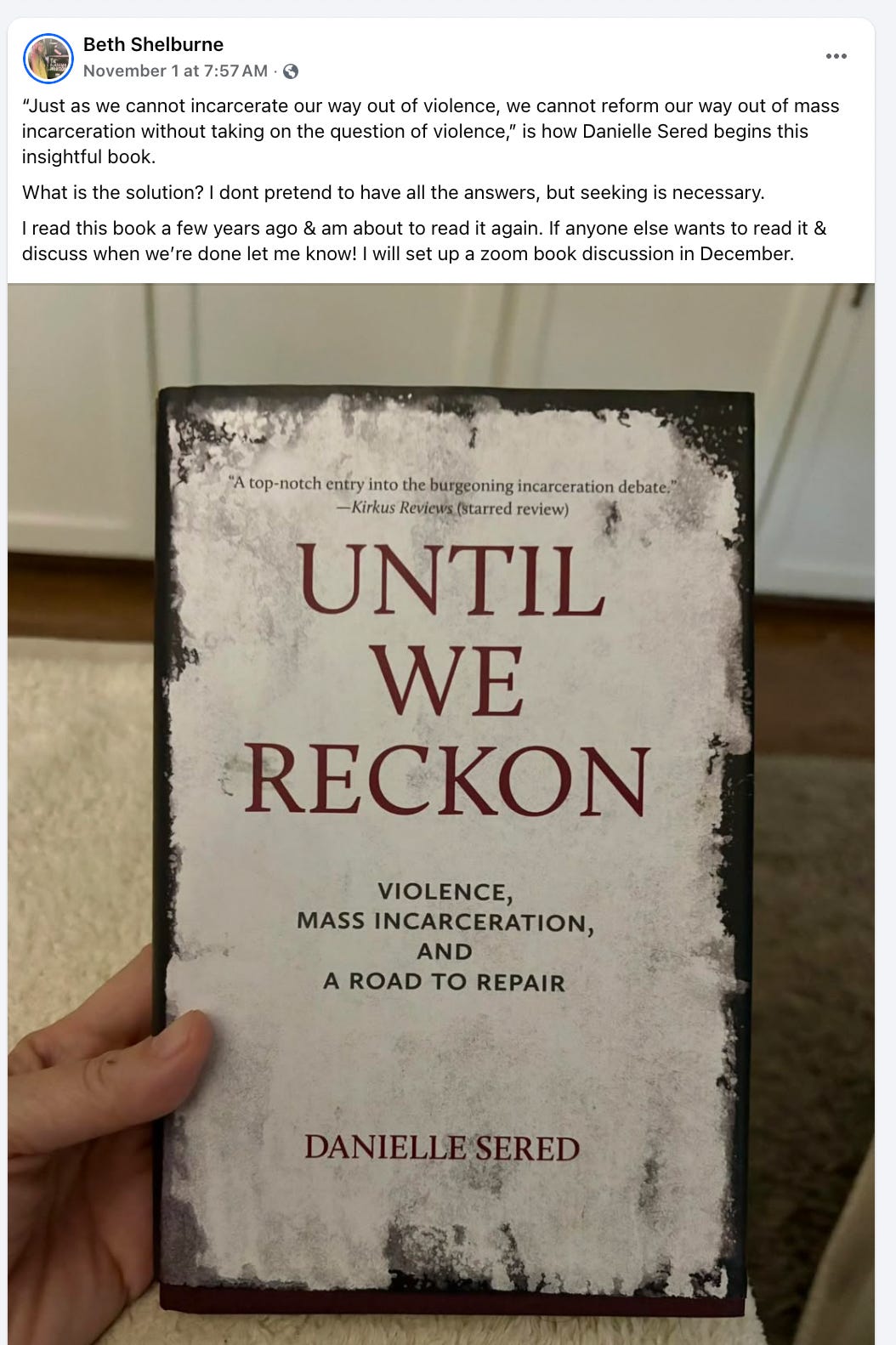
I’ll start by rereading Danielle Sered’s book “Until we Reckon: Violence, Mass Incarceration and A Road to Repair.” If you’d like to read it too, I’ll be hosting a Zoom discussion on the book sometime in December or January. Please leave your email in the comments, and I’ll make sure you’re on the list.
Haney, “Criminality in Context,” 15-20.
After being a hospice Nurse the last 15 yrs and retiring 3 years ago , I dealt with many deaths , families grieving and also had a few men released from prison who were apparently abused and neglected by the healthcare field there, one was a man that went to prison for his second DUI and he was released with cirrhosis of the liver end stage, his pain wasn’t treated there except the last few days there . He said the guard took his pain patch off of him and said he couldn’t leave with that on, so he had nothing. I made sure he had everything he needed as did all of our team members assigned to him. It still hurts my heart today because he wouldn’t go in the house and stayed on the carport and he said that he just wanted to be outside and look at the sky and stars and not be closed up, his last day we got him in the house and his family surrounded him. He finally got peace. I know what the scripture tells us and Jesus said the most important of all is Love! He said if we cant forgive others we can’t be forgiven. We may not like what has been done to our loved ones ( but I don’t want revenge, only justice for my son that died because of ADOC ) I probably will never see that happen but I know that he’s in a better place now , it will be 2 years next week that he was beat in the head causing a traumatic brain injury that caused his death and still no one is held accountable. I forgive them but I don’t forget because we have no closure. Hate will eat you alive and that’s not who I want to be. I’ve been on both sides and it causes misery to both families but unless we can forgive we can’t go forward. People who think “ do the crime do the time” haven’t matured as a person or they wouldn’t have so much hate. I always remind them there is a God!
I taught freshman comp for a community college in a men’s maximum security prison in the early 90s. Prior to that I’d only taught in a public high school.
It definitely gave me a different perspective on our “justice” system and prison systems. Those guys were some of the best students I’ve ever had. Granted, some of them were scheming connivers, but I think that was what worked for them on the inside.
The bottom line is all humans are HUMAN and deserve to have the same basic human rights promised by our Constitution.