
Alabama's two-headed monster
What court documents say about prison understaffing & overcrowding


Almost a decade ago, the man leading Alabama’s Department of Corrections called ongoing issues plaguing the system a “two-headed monster.”
I’ve been studying all available records, trying to get a clear picture on those monstrous two heads: prison overcrowding and understaffing. The records indicate the monster remains ravenous.
The prisons are more crowded now than at any time in the last decade, and despite hiring some new staff, the system still doesn’t have enough officers. Depending on who you ask and how you slice it, the officer vacancy rate across the system is anywhere between 46% and 58%.
And here we are, almost a year past a court-imposed deadline to fill all mandatory and essential posts, but like a mythological serpent, those two heads continue consuming the entire ADOC creature from both ends.
Here I attempt to unpack the situation behind the gates, which is almost impossible to pin down, perhaps by design.
UNDERSTAFFING
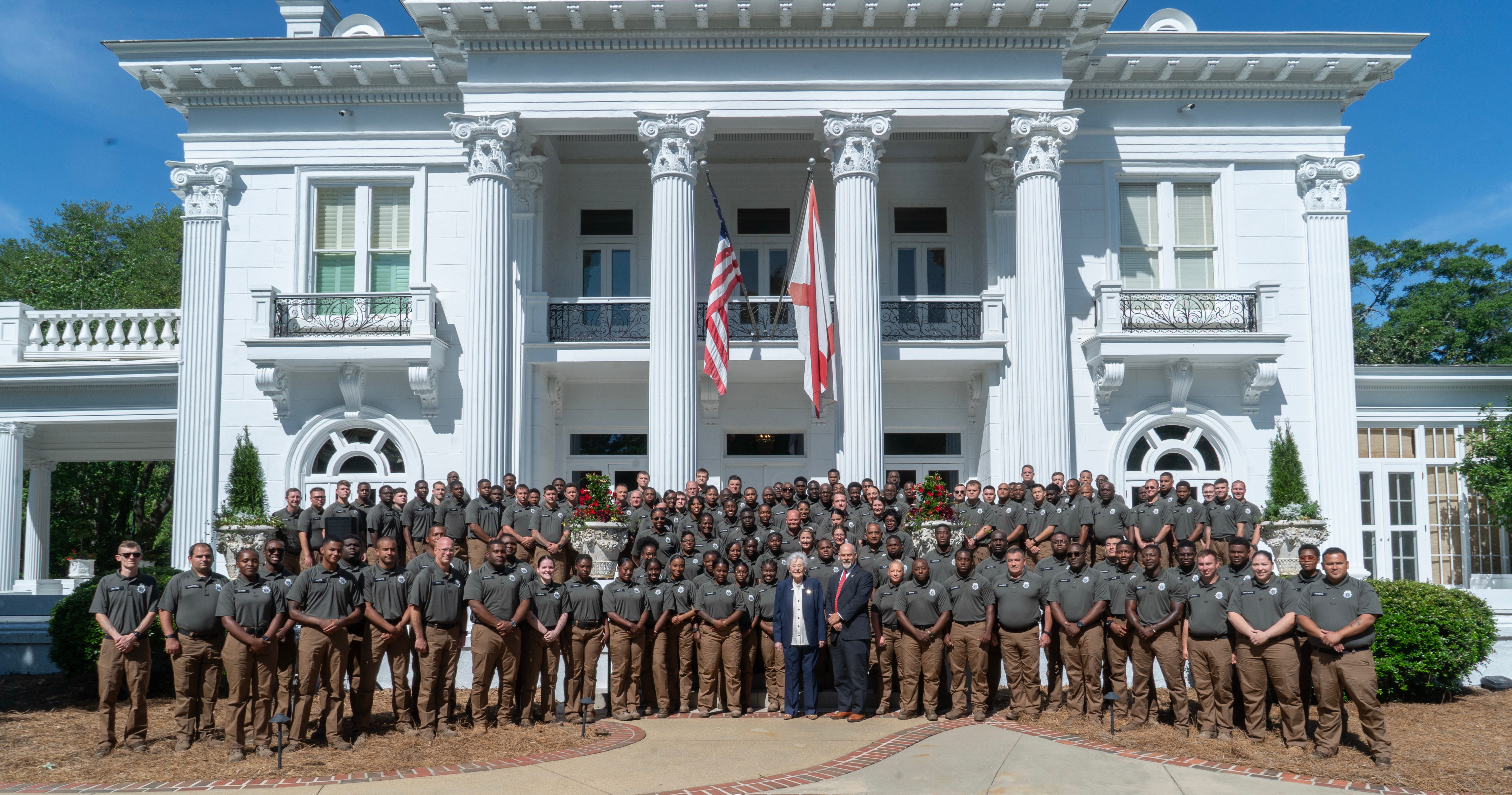
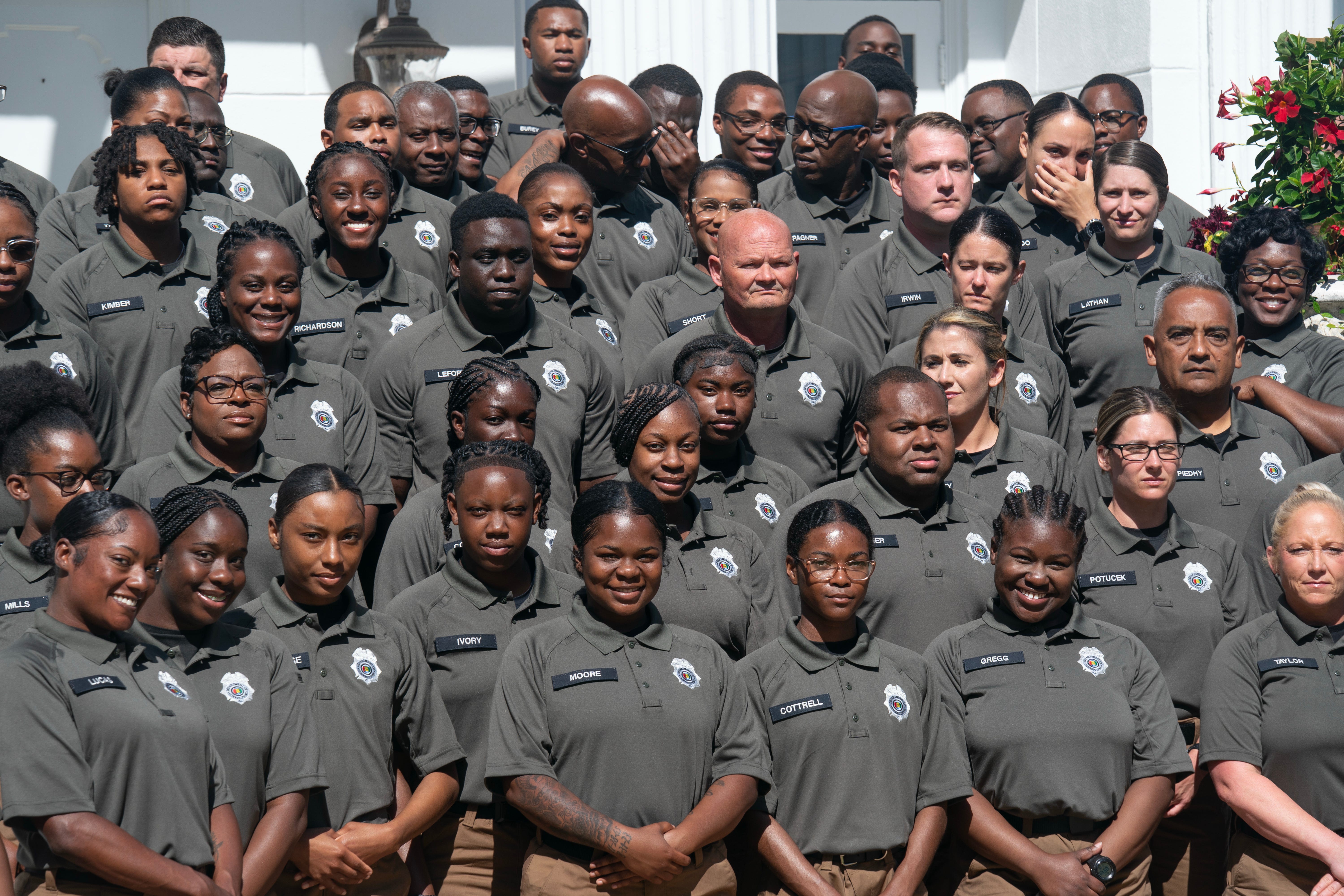
Recent public updates on the prison staffing crisis have been few, yet suspiciously sunny. Former commissioner John Hamm briefed a legislative budget hearing in January, and led his talk by praising Governor Kay Ivey for hosting receptions at the Governor’s mansion for new correctional trainees.
“I think this is a significant indicator of her support for the Department of Corrections and these men and women who do the job everyday,” Hamm gushed.
He continued by describing “significant strides” in hiring, graduating a record 473 new officers from ADOC’s training academy in 2025, but when pressed by a lawmaker on whether that satisfies the court mandate to fill “all mandatory and essential posts,” Hamm conceded that the agency still needed to hire about 1,800 more officers to get to full staff.
This is why I’m attempting to disrupt the polite photo-ops with cold, hard facts, found inside the 4,500 plus documents that make up the docket in the class-action lawsuit filed on behalf of prisoners with mental illness known as Braggs v. Dunn, now in its 12th year of litigation.
Shortly after U.S. District Judge Myron Thompson issued his liability opinion against the state in 2017, calling ADOC’s mental healthcare “horrendously inadequate,” he told the agency that understaffing must be addressed first, and needed to be “fully remedied” before anything else could change. That same month, ADOC stopped including monthly staffing numbers in public reports published on the agency’s website, making progress exceedingly difficult to track.
The latest data filed to the court in June shows ADOC’s total security staffing at 2,003 officers and supervisors. That puts the system’s staffing at 54% with a 46% vacancy rate, IF you believe the argument by ADOC’s lawyers.
ADOC is in clear violation of the Court’s order, is still critically understaffed, and the staffing numbers they’re reporting are inflated, say attorneys for prisoners with mental illness. They argue the more accurate staffing rate is 42% with a 58% vacancy rate, because ADOC is including positions that don’t count toward the recommendations put together by their own experts.
Those include part-time temp help hired from a private security firm, along with two ADOC positions that require only minimal training: correctional cubicle operators and correctional security guards. The agency still needs to hire more than 2,000 officers to satisfy levels set in the expert staffing analysis.
“Today, after more than a decade, little progress has been made, and plaintiffs still await relief,” attorneys for the prisoners write in their latest statement to the court on staffing trends.

The magic number the agency was supposed to hit by July of 2025 was 3,826, at least according to a 2021 remedial opinion on staffing, where I found it on page 5.
The court cited recommendations from an expert staffing analysis that at the time, were supposed to be fully implemented by 2022, including “hiring for the 3,826 full-time-equivalent correctional staffing positions necessary to fill the ‘mandatory’ and ‘essential’ posts.”
The magic number has apparently been revised, because a later filing by plaintiffs in 2024 cited a different number for the required full-time-equivalent officers: 3190.
Lawyers for ADOC insist that staffing analyses remain sealed, so we aren’t allowed to see the expert recommendations, or any revisions, on what constitutes mandatory and essential posts across ADOC’s 27 maximum, medium and minimum-security prisons.
In other words, the agency hasn’t publicly stated a number they are trying to reach, but even if we use the number apparently revised down to 3,190, they are far from reaching it. Calculating from their latest report of 2,003 total staff, they still need to hire 1,187 officers.
ADOC lawyers argue they are making a good faith effort. Twice since 2023, the agency increased starting pay for officers upon completion of the 10-week training academy: $51,727 at minimum security facilities, $54,290 at medium security and $56,971 at maximum security prisons.
If new officers make it 18 months, they’re eligible for a 27% increase. That means potential annual earnings can reach between $65K and $72K, higher than the beginning salaries listed for Birmingham police officers.
Despite the bumps in pay and ADOC’s aggressive recruiting— they’ve spent over $9 million on recruiting and retention bonuses since 2023— it’s been almost a year since the agency missed that deadline to fill all mandatory and essential posts.
So far, Judge Thompson has not held ADOC in contempt, or appointed a special master to monitor compliance, or put the system into receivership, or assembled a three-judge panel to begin releasing people from prison, all options that attorneys for the prisoners have argued the court could impose.
You wouldn’t know any of this adversarial litigation is going on about staffing by reading the PR sent out by ADOC and Gov. Kay Ivey’s office, who’ve been happily proclaiming the number of graduates from the state’s correctional academy each quarter, along with photos from that celebratory reception at the Governor’s mansion.
A brief Braggs timeline:
The lawsuit was filed in 2014, and after a trial, Judge Thompson issued his major ruling against ADOC in 2017. At his direction, the state hired a pair of correctional experts to conduct a staffing analysis in 2018, and the recommendations in their analysis, which I mentioned remains under seal, set out the specific staffing goals to remedy the system’s crisis.
Judge Thompson initially set a deadline for 2022, giving ADOC four years to hire enough officers to meet the recommendations.
At the time, prison staffing had reached historic lows. In 2018, they reported just 1,548 total staff, which meant 60% of authorized positions were sitting vacant. Between the pandemic, mandatory overtime and poor management, the agency continued to hemorrhage.
Former commissioner John Hamm acknowledged this undoing, telling the legislative prison oversight committee in January that ADOC probably lost 800 officers between 2019-2020.
By June of 2021, the agency employed only 1,837 officers and supervisors, almost 2000 officers short of the number set by the court. The agency limped along, and tried to make up lost ground but the hole was deep. They asked for more time.
At the end of 2021, Judge Thompson granted it, extending the new staffing deadline to July of 2025, which we know has come and gone.
I’ve been covering stories about the hemorrhaging staff for over a decade. In 2016, an experienced officer told me he was trying to decide whether to quit after one of his fellow officers was stabbed inside St. Clair Correctional Facility, followed by a feeble agency response.
“What’s it going to take to get help in here?” he said. “Is one of us going to have to get killed?”
Sadly, six months later, an ADOC officer was killed inside another prison. Officer Kenneth Bettis, 44, was stabbed to death inside Holman Prison in September of 2016. The following year the state issued a $750,000 settlement payment to his family, according to records from the Dept. of Finance.
I recall speaking to one of Bettis’s colleagues, a woman, who told me she walked out of the prison that day and never went back. When we spoke on the phone weeks Bettis was killed, she was suffering from severe PTSD and still wasn’t sure if she wanted to talk publicly about what happened. I remember the pain in her voice— her fear and rage, that ADOC put Bettis in that position. She told me she’d think about speaking on the record, but I never heard from her again.
The point is that operating short-staffed prisons harms everyone, not just incarcerated people. It also costs taxpayers tens of millions of dollars in litigation and settlements that result from the ongoing harms.
How does the Kay Ivey mega-prison factor into this? Attorneys for the plaintiffs in Braggs say the state has not presented any information that demonstrates the mega-prison will need fewer correctional officers. And because the plan calls for existing beds to be replaced by spots in the mega-prison, the need for similar correctional staff remains.
Who will work in the new facility, scheduled to open later this year, and what does that mean to existing staff? Let’s hope lawmakers start demanding answers.
OVERCROWDING
Unlike understaffing, leaders in Alabama have never meaningfully addressed this problem, they don’t even like to talk about it. They’ve even admitted their billion dollar mega-prison under construction does nothing to address crowded conditions, it just provides a new, expensive place to shift people.
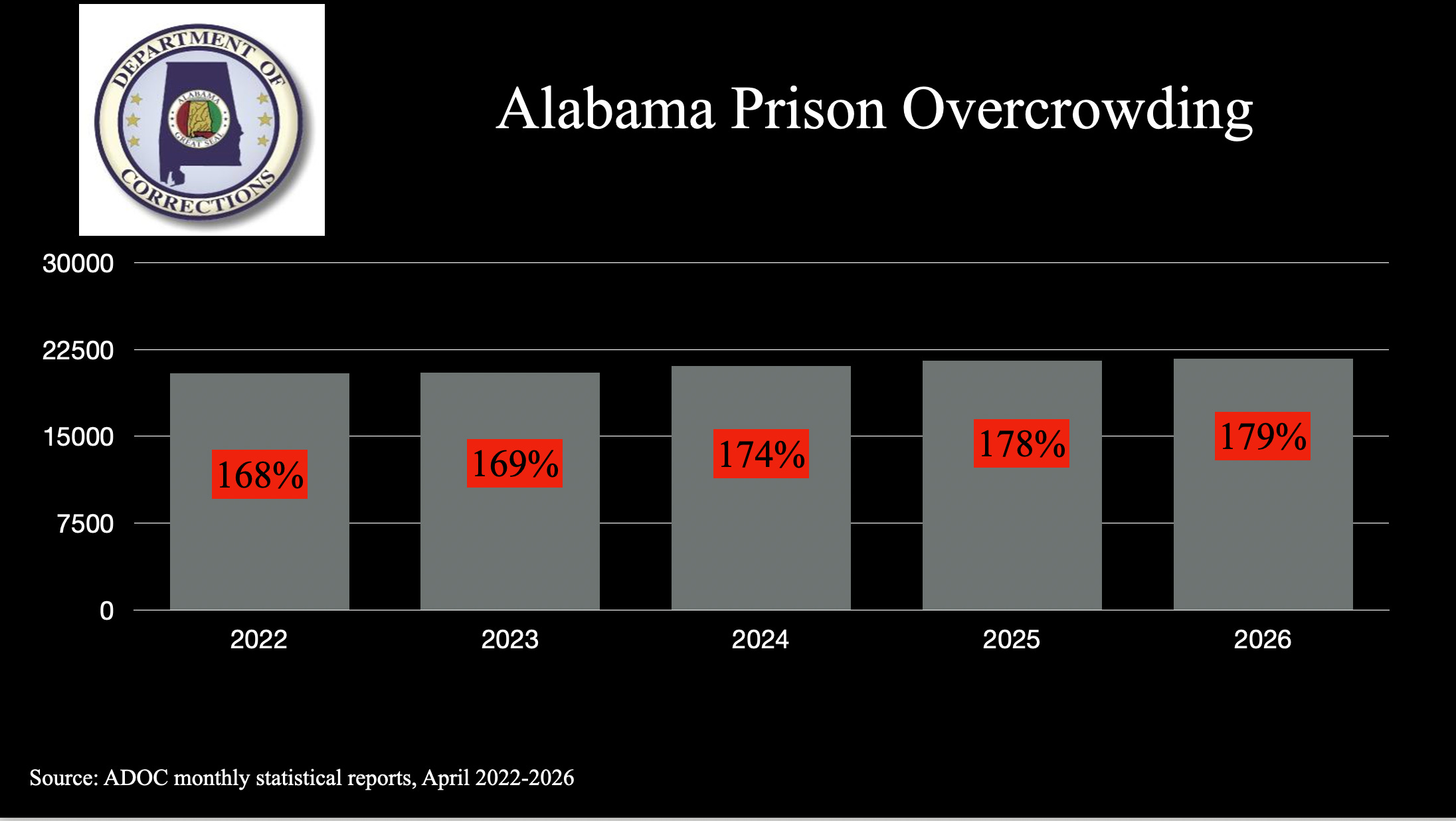
Current data shows the prisons are more crowded today than at any time in the last decade, despite the U.S. Department of Justice suing the state in 2020 for refusing to correct unconstitutional conditions— the failure to keep incarcerated people safe from violence, sexual assault and excessive force, and citing overcrowding as one of the main drivers causing the constitutional violations.
The state’s prison system is designed to hold 12,115 people. The latest ADOC statistical report from April shows facilities stuffed to 179 percent over the designed capacity. The total custody population is 21,729, where it has hovered for the last 18 months. The last time the population dipped below 21,000 was in July of 2024.
For people inside the prisons, this means living every minute of your life in a unmanageable crowd. It means sleeping within arms length of other adults, zero privacy, wait times for everything from phones to toilets to food to medicine. A dorm stuffed with 200 men has only seven working showers.
It means there is no escape from other people, who may be experiencing distress from addiction, mental illness, or victimization. And don’t forget there’s no air conditioning.

But the state legislature seems to view the prison doors as one way only: regularly increasing punishments to drive more people into prison while sitting on their hands when it comes to creating pathways out of prison.
See their failure to pass the second chance bill, designed to help older people serving life sentences under the state’s habitual offender law, championed for many years by Alabama Appleseed. In 2025, despite a Republican sponsor and support from Governor Ivey, the bill was never brought to a full vote and ultimately died, the tough-on-crime cabal working behind the scenes to kill it.
Another factor driving prison crowding is the draconian decline in parole releases, which reached an historic low in 2023 when the board denied 92% of qualified applicants.
There’s been some improvements in parole grants following last year’s exit of board chair Leigh Gwathney, a career prosecutor who consistently voted no, even in cases in which candidates were already working under community supervision, or elderly and disabled, and in at least one case, already dead.
The latest statistical report from the Bureau of pardons and paroles shows the current grant rate now at 19%, which is better than the low of eight percent, but still means the vast majority of qualified parole candidates, 81%, are being denied release.
I wish I could end this reporting with a hopeful nugget, but overcrowding is not expected to improve anytime soon. Alabama’s Sentencing Commission predicts the prison population will continue to swell, reaching up to 28,000 people by the year 2030.
There is power is knowing the facts in this tedious jumble of available data, and a better understanding of ADOC’s two-headed monster is necessary to hold the system accountable.
And maybe that’s the hopeful part. The more we know, the stronger and louder we can insist on change.
If you live in another state, I’d love to hear how the two-headed monster of prison overcrowding and understaffing is playing out where you live.
Please, please keep disrupting the polite photo-ops with cold, hard facts...